Amazon Rainforest Tour vs. River Cruise: Which Fits Your Trip?
Two formats dominate the Brazilian Amazon and they are not variations on the same holiday. A river cruise carries you, feeds you and sleeps you while the forest slides past the window. A guided jungle trip out of Manaus puts you in the forest and sends you into it on foot and by canoe. This guide compares both on price, effort, comfort and wildlife access, and is straight about which one we actually sell.
Choose between a lodge base and sleeping aboard a traditional riverboat. Explore Three-Day Amazon Wildlife And Culture Adventure ↗
Google's own AI summary for Amazon rainforest tours frames the reader's decision in exactly these terms, jungle lodge and tour on one side, river cruise on the other. That is a fair signal of how many people arrive at the question undecided, and of how rarely anyone answers it without selling something. So here is the version with the sales pressure removed as far as it can be.
One disclosure first, because it shapes everything below. We do not book river cruises. The 14 tours listed on this site are jungle-based: day trips, evening outings, overnights at a floating house, and multi-day lodge, camping and kayak trips, most of them running out of Manaus with a couple departing from Leticia at the three-country border. We can describe the cruise format fairly and tell you who it suits. We cannot recommend a specific vessel, and we are not going to pretend to.
Jungle tour or river cruise: price, shortest trip, and how active each one is
Jungle-tour figures are the real published prices of the 14 tours listed on this site, from $38 to $1,100 per person. The cruise band is the typical published range for multi-day luxury Amazon river cruises, $1,200 to $5,000 and up per person. Activity and proximity levels are qualitative, based on what each format's day is built around, not a score.
The quick answer
Take the river cruise if comfort, distance covered and a gentle physical load matter most, and a starting budget near $1,200 per person works. Take a guided jungle tour from Manaus if you want to be in the forest rather than looking at it, do not mind mud, heat and paddling, and want the freedom to spend anywhere from $38 to about $1,100.
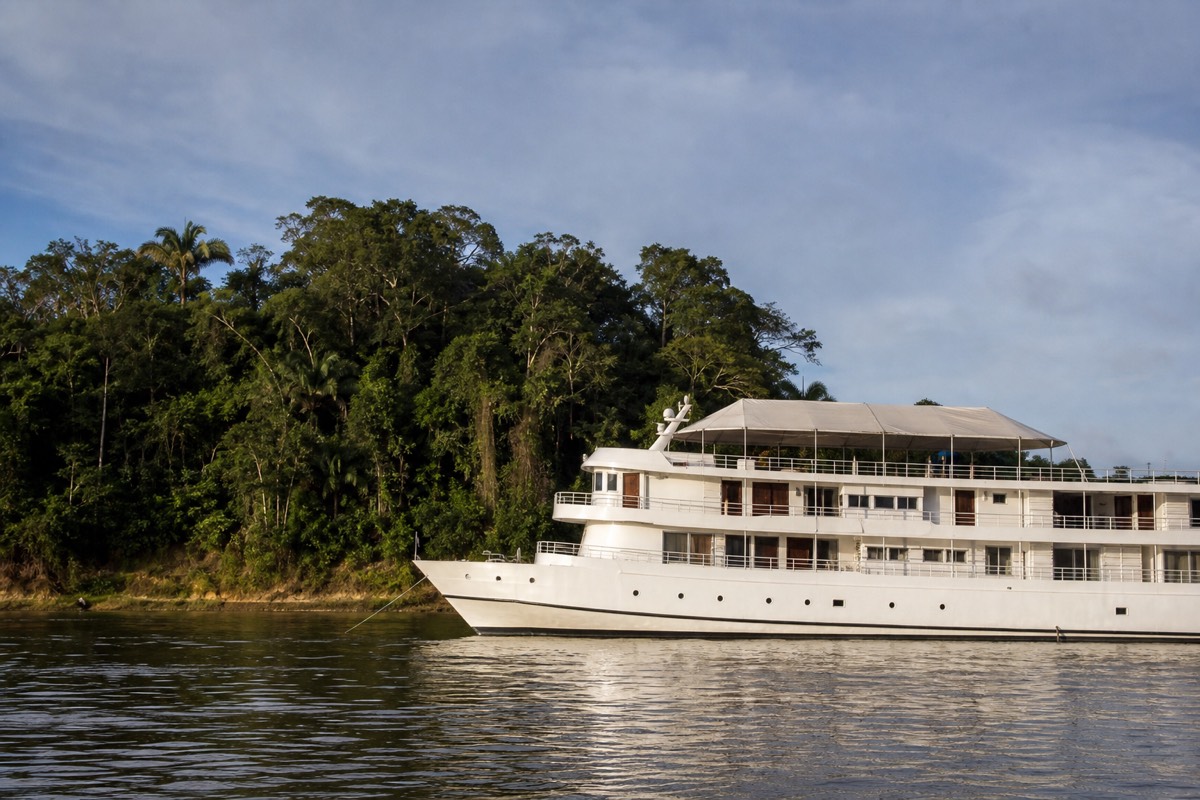
Trip choice: Canoe trips, a jungle hike, night wildlife outings and a sunrise, with air-conditioned cabins and a private bathroom. Explore This 3 days Experience ↗
What actually counts as an Amazon river cruise?
A river cruise is a floating hotel with a route. The vessel is your bedroom, your dining room and your transport at once, so you cross long stretches of water while you sleep and wake somewhere new. Wildlife viewing is river-focused by design, and the forest is a place you go out to rather than a place you stay.
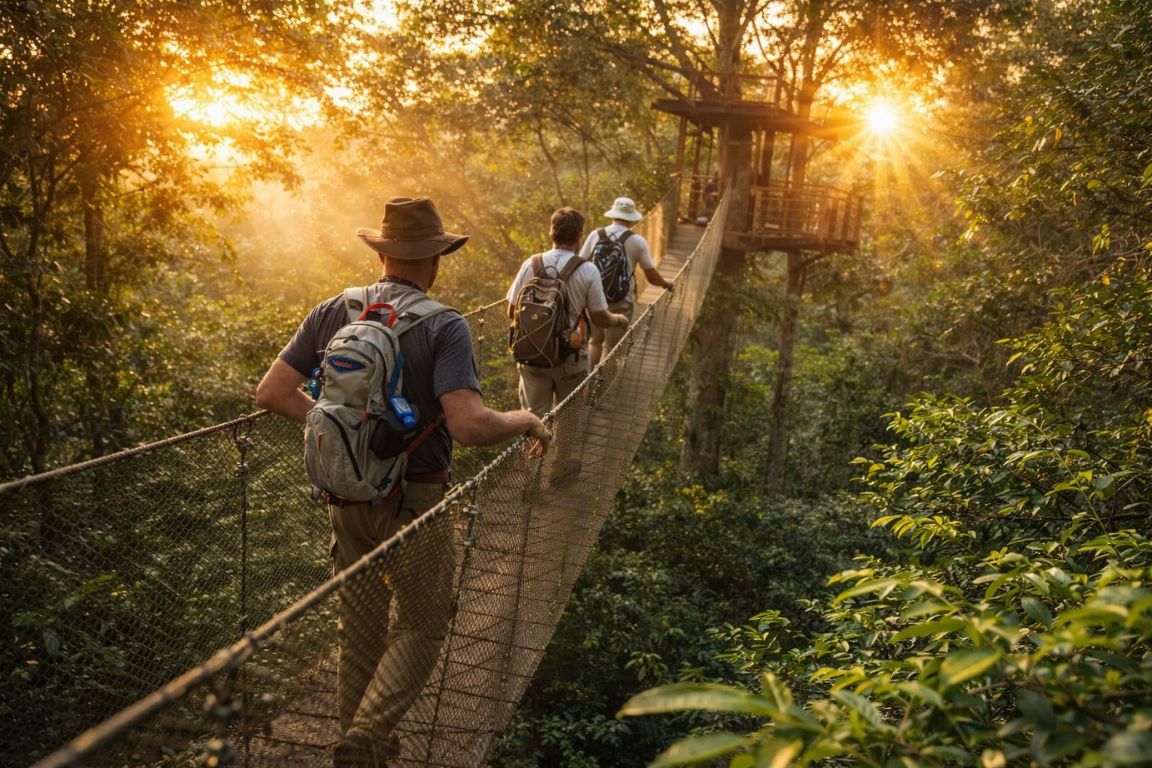
That single structural fact drives most of the differences that follow. Because the boat moves overnight, a cruise covers far more river than any land-based trip can, and because the boat is also the accommodation, the comfort level travels with you: the same cabin, the same bed, the same kitchen every night, no repacking. For a lot of travellers that is worth real money, and the published prices say so. Multi-day luxury Amazon river cruises typically run from about $1,200 to $5,000 and up per person. Mid-market riverboat cruising sits lower, roughly $150 to $400 per person per night, a band our guide to where to stay in the Amazon sets against the lodge options.
The trade-off is the one you would expect. When the vessel is the base, the river is the main character and the forest is the backdrop. You see the Amazon at the scale of a landscape: the width of the water, the wall of green on both banks, the birds working the margins, the light at dawn. What you get less of is the smell of wet leaf litter, the guide stopping to break a stem and hand you the sap, the hour spent standing still in a flooded forest waiting for something to move.
What actually happens on a jungle tour from Manaus?
A jungle tour is built the other way round. You are based on land or on a floating house, and the day is a sequence of outings: a trek, a canoe run down a narrow channel, a swim, a fishing stop, a night spotlight. The forest is not scenery you pass. It is the room you spend the day inside.
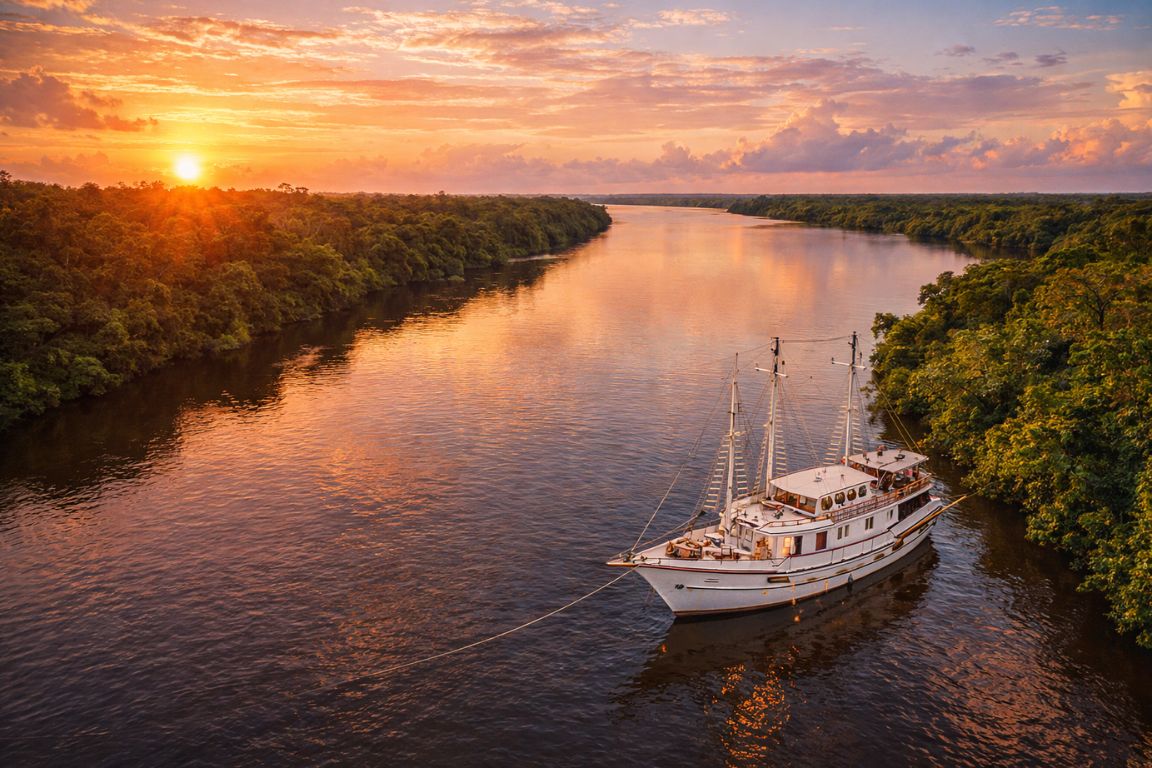
The shape is remarkably consistent across the tours listed here, whatever the length. A full jungle day from Manaus generally runs an hour west by road, then swaps to a motorised canoe. From there it is two to three hours on the trails with a bilingual guide talking through medicinal plants, trees, insects and survival technique, an hour at a protected platform where pink river dolphins come in, a simple lunch of fish or chicken with rice, beans and manioc at a floating house, an afternoon of piranha fishing in the small canals, and a sunset run that turns into caiman spotting by torchlight. Groups are small on most of them, capped at 10 or 12.
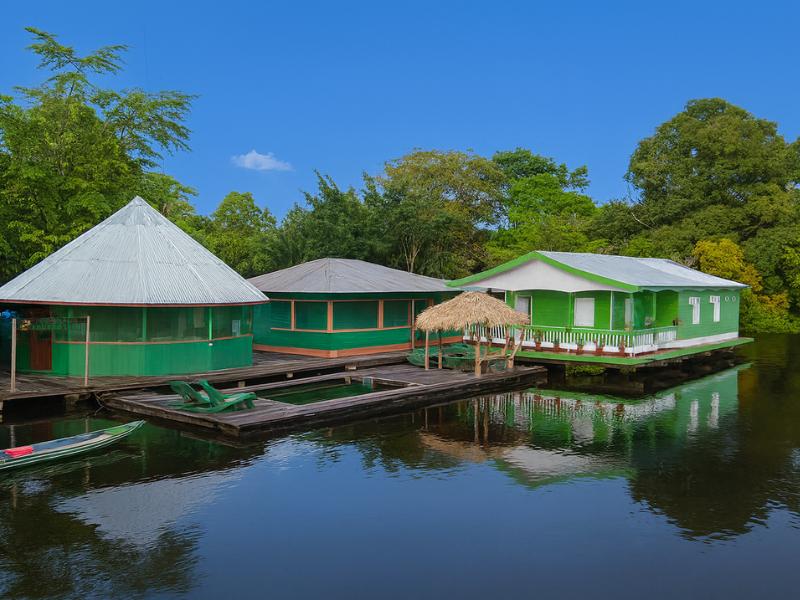
Stretch that to two days and you add a night at a floating house and a sunrise cruise, which is when the forest is loudest. Stretch it to three or five and you move to a lodge on the Juma or Mamori side, roughly 100 km south of Manaus, with air-conditioned rooms and mosquito nets, all meals, and days that fill with kayaking flooded forest in the wet season or walking trails in the dry. At the far end you can sleep in a hammock in the forest itself.
| Trip shape | Real example from this site | Length | Price per person |
|---|---|---|---|
| Half-day boat and trails | Amazon Jungle Safari from Manaus | 6.5 hours | $38 |
| Evening outing | Manaus evening tour, piranha fishing and caiman watch | 5 hours | $90 |
| Full jungle day | A Whole Day in the Brazilian Amazon Jungle | 12 hours | $100 |
| Overnight | Amazon Jungle Tour: Overnight Rainforest Experience | 2 days | $300 |
| Short lodge stay | 3-Day Wildlife, Culture and Pink Dolphins Adventure | 3 days | $500 |
| Paddling expedition | Amazon Kayak Expedition | 4 days, 3 nights | $659 |
| Camping and survival | Multi-Day Survival Trip with Camping from Manaus | 3 to 5 days | $660 |
| Longest lodge stay | Tapiri Floating Lodge, Multi-Day Amazon Experience | 3 to 5 days | $1,100 |
| Multi-day luxury river cruise | Not sold here | Multi-day | $1,200 to $5,000 and up |
How much does each one really cost?
The gap is wide enough to decide the question for a lot of people. The cheapest jungle option on this site is $38 and the most expensive is $1,100 for three to five days. Published multi-day luxury cruise pricing starts around where our longest lodge stay ends, at roughly $1,200 per person, and runs to $5,000 and beyond.
Read that carefully, though, because the two numbers are not measuring the same thing. A cruise price is close to all-in: the vessel, the cabin, the meals, the crew, the excursions and the distance covered are one figure. A jungle tour price is also mostly all-in on the tours listed here, with transfers from your Manaus hotel, meals and guiding bundled, but it does not include the nights you spend in Manaus before and after, and the shorter tours obviously do not include a bed at all.
The honest way to compare is by total nights away. If you want six nights inside the Amazon, a cruise is the format that delivers six nights and a lot of river for a single price. If you want two or three nights inside the forest and would rather spend the rest of the budget on getting there, or on somewhere else entirely, the jungle side wins on flexibility by a distance. Nothing in the cruise market lets you test the Amazon for $38.
Which one gets you closer to the wildlife?
The jungle format, for the animals most people come to see. A boat deck is a superb platform for birds, river dolphins and distance, but caimans by torchlight, monkeys overhead on a trail, piranhas on your own line and the small, strange things a guide finds in the leaf litter are all a matter of standing in the forest rather than passing it.
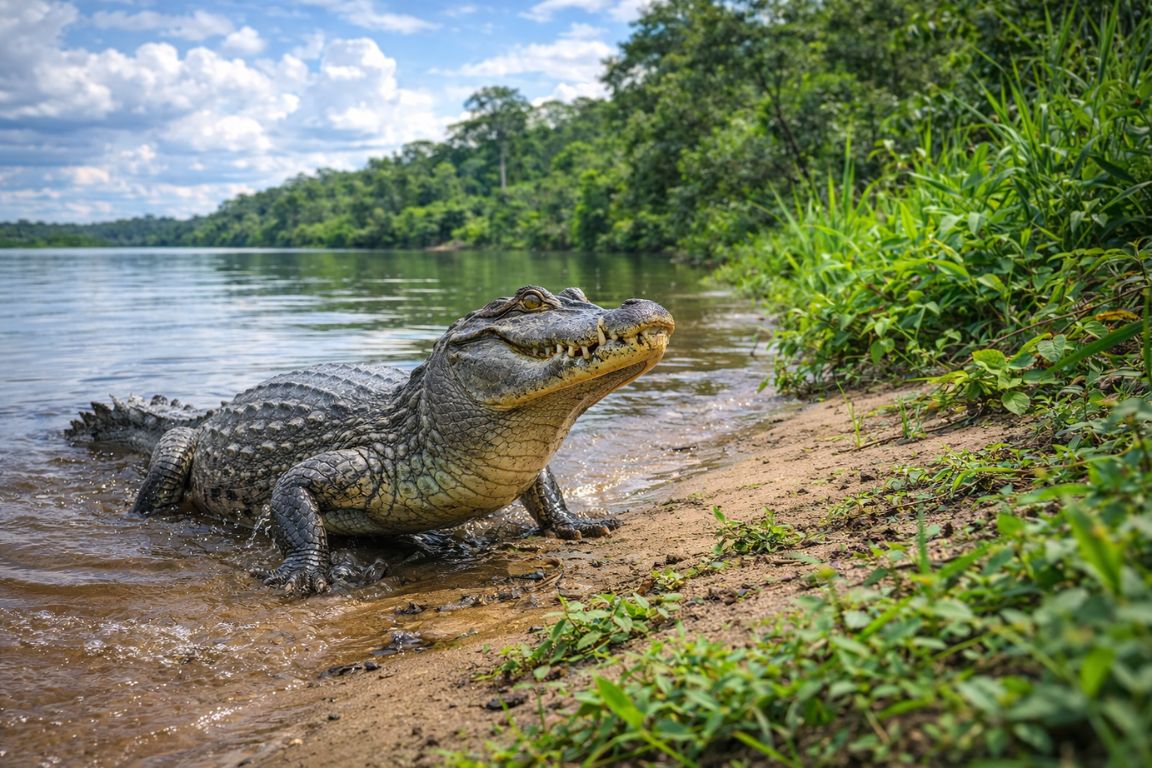
Be realistic about what the Amazon delivers either way, because this is where trip reports turn sour. Dense forest hides big animals extremely well. The listings on this site say so plainly: high odds on birds, monkeys, caimans and dolphins, and a frank note that the larger animals are elusive. Jaguars live in the Amazon biome, but reliable sightings are far more associated with the open Pantanal wetlands than with river and jungle trips out of Manaus, and none of the 14 tours here offers them as a feature. Anyone promising you a jaguar is selling you something.
What both formats do well is the water. Pink river dolphins are a genuine highlight and several of the tours here include time at a protected platform where they come in close, sometimes for a swim. Birds are excellent from a deck, which is the cruise format's real strength, and there is a full-day birdwatching tour with a private guide on this site for people who want that as the whole point rather than a bonus.
| What you hope to see | Jungle tour | River cruise |
|---|---|---|
| Pink river dolphins | Strong, often at a protected platform with a swim option | Strong, river-focused viewing |
| Birds, including macaws and toucans | Strong on trails and from canoes | Strong, the deck is a good platform |
| Caimans at night | Strong, guided spotlight outings are a standard inclusion | Depends entirely on the itinerary |
| Monkeys in the canopy | Good, and better on foot than from open water | Occasional, from the boat |
| Piranhas on your own line | Yes, a standard activity here | Not a cruise staple |
| Jaguars | Very unlikely, and not sold as a feature | Very unlikely |
| Medicinal plants and forest craft | Central to the guiding on almost every tour here | Limited by time ashore |
How physically demanding is each format?
A cruise asks very little of you: walking on and off the vessel, some steps, whatever shore time the itinerary includes. A jungle tour asks for moderate fitness. Nothing here involves climbing, but the trails are uneven, muddy in the wet season, and the days are long, so knees and stamina matter more than strength.
The tours on this site are direct about it. Trails are described as moderate walking with uneven ground, guides adjust the pace, and guests with average fitness handle them. Canoe rides are calm. What catches people out is not the difficulty of any single activity but the accumulation: a 12-hour day that starts with an 8am hotel pickup and ends with a drop-off around 8.30pm, in humidity, with insects, is tiring even though nothing in it is hard.
Accessibility is worth stating plainly because it is a real dividing line. Most of the jungle tours here are not wheelchair accessible, for the obvious reason that jungle terrain and small boats are not. One exception exists on this site: the half-day jungle safari from Manaus lists a wheelchair-accessible boat. If mobility is the constraint, that is the honest starting point on the jungle side, and the cruise format is worth serious consideration on its own merits.
| Demand | Jungle tour from Manaus | Multi-day river cruise |
|---|---|---|
| Walking | 2 to 3 hours on uneven trails is typical | Whatever the shore excursions involve |
| Day length | Up to 12 hours door to door on the full-day tours | Paced by the vessel's schedule |
| Heat and humidity exposure | High, most of the day is outdoors | Moderate, you can retreat indoors |
| Insect exposure | High, repellent is treated as essential | Lower while aboard |
| Mobility limits | Mostly not accessible, one accessible-boat option here | Generally the gentler format |
How long does each format need?
A jungle trip flexes from a single afternoon to five days. A cruise does not: it is a multi-day commitment by definition, since the vessel needs distance to justify itself. If you have one free day in Manaus, the choice is already made for you.
This matters more than it sounds, because plenty of people reach the Amazon with a fixed gap rather than an open calendar. A stopover in Manaus, a couple of spare days at the end of a Brazil trip, or a single day between flights all rule the cruise out and leave the jungle tours as the only way to see anything at all. Working out how many days you need is the step most people skip, and it usually settles the format question without any further debate.
| Time you have | What works |
|---|---|
| Half a day | The 5-hour evening outing or the 6.5-hour safari, both jungle-side |
| One full day | A 12-hour jungle day with trek, dolphins, fishing and night spotting |
| Two days | An overnight rainforest experience at a floating house |
| Three days | A lodge stay, or the shortest end of a cruise itinerary |
| Four to five days | Kayak expedition, survival camping, or a full lodge stay |
| A week or more | Where the cruise format genuinely comes into its own |
Do both formats show you the Meeting of the Waters?
Yes, and it is one of the few highlights the two formats deliver almost identically, because it happens on the water either way. The dark Rio Negro and the pale, sediment-heavy Rio Solimoes run side by side for roughly 6 km, about 3.7 miles, near Manaus before they finally mix.
The reason they stay separate is not one thing but four: the rivers differ in temperature, speed, density and sediment load, and it takes turbulence, wind and the river's own bends to blend them. The Negro is cool, slow, acidic and nearly sediment-free, its colour coming from dissolved organic matter. The Solimoes is warmer, faster and loaded with sediment carried down from the Andes. Seen from a boat the line between them is absurdly sharp, which is why nobody photographs it well and everybody tries.
On this site it appears on several tours, including the Meeting of the Waters tour with pink dolphins and lunch, the half-day safari, and as a stop on the way out to the lodges on the multi-day trips. If it is high on your list, it is not a reason to pick one format over the other. It is a reason to check that your specific itinerary passes it.
What about comfort, sleeping and food?
Cruise comfort is consistent and portable: one cabin, one bed, one kitchen for the whole trip. Jungle comfort varies enormously by product, from an air-conditioned lodge room with a mosquito net at one end to a hammock strung in the forest at the other. Neither is better. They are different promises.
The jungle listings here are unusually honest about this, and that honesty is worth reading before you book. The multi-day lodge stays describe private rooms with air conditioning and mosquito nets, all meals included, and cool nights that want a layer. The survival and camping options describe hammocks with mosquito nets in remote spots, which guests describe as rustic and thrilling in the same sentence. Food across all of them is simple and regional rather than varied: fresh fish or chicken, rice, beans, manioc, fruit. Vegetarians are told plainly that options are limited and that advance notice helps, which is the sort of thing a brochure usually buries.
If your idea of a good trip includes a proper shower, a varied menu and a bed you do not have to think about, a cruise or a luxury jungle lodge is the honest answer, and pushing you onto a camping trip would be a disservice. If you would happily trade the menu for the sound of the forest at 3am through a mosquito net, the jungle side is where that lives.
| Jungle tour | River cruise | |
|---|---|---|
| Where you sleep | Floating house, lodge room with A/C and net, or a hammock | A cabin on the vessel, the same one every night |
| Repacking | Once, if the trip changes base | None, the boat moves with you |
| Food | Simple regional cooking, fish, rice, beans, manioc | Set by the vessel's kitchen |
| Dietary flexibility | Limited, advance notice matters | Generally easier on a full kitchen |
| Air conditioning | On lodge rooms and transport, not everywhere | Standard on the cabin |
Which format suits which traveller?
Match the format to the trip you already want, not to which is objectively better. There is no objectively better. There is a version of the Amazon that suits how you like to travel, and a version that will quietly frustrate you for a week.
| If this is you | Pick | Why |
|---|---|---|
| Testing the Amazon on a short stop in Manaus | Jungle day trip | Cruises have no day-trip version, and $38 to $110 buys a real day |
| Travelling with limited mobility | Cruise, or the accessible-boat safari here | Trails and small canoes are the barrier, not the region |
| Wanting hands in the mud and nights in the forest | Jungle lodge or camping trip | The whole day is built around being out in it |
| Prioritising comfort and a single unpacked bag | Cruise | One cabin, one kitchen, distance covered overnight |
| Travelling with children | Jungle day trip or overnight | Dolphins, canoes and piranha fishing hold attention on a shorter day |
| Serious about birds | Either, but book a specialist | A private birding guide beats a general itinerary in both formats |
| Budget under $500 for the Amazon leg | Jungle | Cruise pricing starts well above it |
| Two weeks and a taste for slow travel | Cruise | Distance covered is the thing only a vessel can give you |
The mistakes that make people regret the choice
Almost every disappointed Amazon review traces to one of four things: expecting a safari-style parade of large animals, underestimating heat and insects, booking a format that does not match your appetite for effort, or squeezing the forest into a gap too small for it.
The wildlife expectation is the big one. The Amazon is not the Serengeti and never has been. It is dense, green and secretive, and its rewards come in small increments: a sloth spotted by a guide who knew where to look, a flock working the canopy at dawn, a caiman's eyeshine at the edge of the torch beam. Both formats deliver that. Neither delivers a big cat on demand.
The second mistake is booking for the person you wish you were. A five-day survival trip with hammock camping is a wonderful thing for someone who genuinely wants it and a long week for someone who does not. The third is thinking the price gap is the whole story, when the real question is how many nights you want inside the region. The fourth is treating the Amazon as an add-on: one rushed afternoon after a long flight, in the heat, is how people conclude the rainforest was overrated.
So, tour or cruise?
If you want the forest at arm's length, if you would rather walk a trail than watch one go by, and if the budget matters, the jungle format is the better trip and we will say so without hedging. If you want distance, comfort and a gentler pace, a cruise is a fine choice and no jungle tour on this site can replicate it. Both are real ways to see the Amazon.
For everyone in the first camp, the practical route is to pick a length and let the rest follow. One day is the overnight rainforest experience minus the night. Two days adds sunrise on the water, which is when the forest is at full volume. Three to five days at the Tapiri floating lodge or on the multi-day survival trip is where the region stops being a day out and starts being somewhere you have actually been. Our guided Amazon tours from Manaus cover all of those lengths, with hotel transfers, meals and bilingual guiding built in, and prices and departure dates shown live on the operators' own listings.